Crowdsignal blocks in WordPress

Welcome to this little demo page! We would love to introduce you to our set of Crowdsignal blocks and created this post for you, so that you can test and play with all of them right inside of your editor.

Preview this post if you would like to test the Crowdsignal blocks from your visitors perspective. Oh and please feel free to delete this draft post anytime, it was only created for demo purposes.

Overview

Let’s start with a quick overview of all our current blocks available in your WordPress editor. You can find all these blocks inside your block library via searching for their name or simply by searching “Crowdsignal”.

If you want to learn more about Crowdsignal please go to crowdsignal.com and join our little community all about feedback here.

Polls

We all have opinions! Curious about the opinion of your audience? Start asking with our poll block. It makes creating a poll as fast and simple as listing bullet points.

 You can choose between a button or a list style for your answer options, and you can fully customize the styling of the block.  By default the poll block will support your theme styling, but it’s up to you if you want to keep it. You can customize the style how you want, from font-family to border colours.

Just click in the poll below and start editing.

And everything else you expect from a Crowdsignal poll is also available — such as setting “single answer” or “multiple answer” choices, a customised confirmation message, poll timeframe, and avoidance of double voting.

Here is a short demo video for how to set up this block, not that you would need it 😉

Feedback Button

You might have spotted it already, in the bottom left corner of this page: Our Feedback button.

This is a floating button that lives above your site’s content. Always visible this button makes giving feedback easy! User can send you a message and provide their email address so you could can get back to them. Needless to say that you can fully customize the design and text, including the label of the button itself. Feel free to make it a “Contact me” or “Say hello” button or anything you like.

And yes, you can change its placement! You can put the button in any corner of your site. Just try it! Click in the feedback and start editing.

Don’t miss out on your customers’ feedback. Keep your door open anytime and place a feedback button on all your pages.

Voting

Sometimes we need just quick and fast feedback from our audience. A quick voting button might be all you need. Fully customizable of course.

There is already a “like” button at the end of a WordPress post that you can click to express satisfaction or agreement. But what if you want to ask readers their opinion on a subject in the middle of a post? Or what if you want to present several ideas and find out which one is the most popular? Wouldn’t it be great to ask readers what they think without having to leave the editor or switch to another service or plugin?

That’s what we thought! Say hello to our Voting Block:

It’s a simple block that adds two voting buttons—thumbs up, thumbs down—to your post wherever you want to place them. Customize the block in different sizes and colors, with or without a border, and with or without a visible vote counter. Put several in a single post, next to different ideas, to see how they stack up for readers. Make the block your own!

Applause

The Applause block is a simpler and more playful version of our Voting block. The main differences are users only being able to give positive feedback and encouraging users to “make as much noise as they want”. Meaning this block does not only allow repeated voting, but even encourages it.

Let your audience make some noise with a big round of applause.

Preview this post and try clapping yourself! It’s fun.

The block currently comes in three different sizes, and can be customised with a button-like styling, including a border, border radius and some colour customisation options.

Embed Surveys & Forms

So far we only talked about quick and fast ways to collect feedback or opinions from your audience. But what if you have many questions or want to create simple forms? You can do this with Crowdsignal, too! Create a survey or form on app.crowdsignal.com and embed it into your WordPress post or site. Similar like here:

The Crowdsignal survey above was embedded using our “Single question per page mode.” It’s exactly what it sounds like: In this mode, no matter how many questions your survey has, your respondents will always see one question at a time. Single Mode shines when you embed a survey into your website or blog post. Surveys with multiple questions can take up a lot of space, overwhelming your site. If you’re not sure whether your readers will take the survey at all, it disrupts the reading experience. With Single Mode, a survey  uses the same amount of space as an image, even a really long survey.

Once they provide an answer (or skip the question),  the next question loads. It has a playful  feel, like flipping through a slide show. Every answered question feels like progress.

You can choose between several transition options, and decide whether the questions should move from top to bottom, or from left to right.

Ready to create one? Here’s how:

– Go to app.crowdsignal.com (we will log you in with your WordPress.com account – magic ;)) .

– Create a new survey.

– In the Editor, choose “Single Mode” at the top left.

– Then create as many questions as you like and style your theme.

– When you are ready click on Sharing and copy the URL of your survey.

– Go back to your WordPress editor and paste the URL of your survey into your post

– Done! Your survey will appear in your post.

Here is a short demo video for you that shows you how it works in less than a minute:

Measure NPS

While we are driving our projects, working hard on our products, we all wonder: How are we doing? Are people satisfied with our service? Are we doing better since last month? 

Sometimes you want to measure your progress over time. Measure and monitor the customer satisfaction and growth potential of your product with a Net Promoter Score.

We have built a Gutenberg block for you that makes it easier than ever before to track your Net Promoter Score on WordPress. If you have previewed this post before, you might have seen the NPS question already in a modal window.

The moment you add the block, you are basically done. The design of the block is based on your site’s theme. You can still customize the styling of the block, or edit the questions, but that might not even be necessary.

To get the most out of your NPS data, it is important to show the question only to users that are already familiar with your service or product. You can configure the block to only show to repeat visitors. It’s more likely you will get feedback from someone who knows what they are talking about, and you can make sure new users are not interrupted during their first visit to your site.

After you publish the block go to the results page of the block and monitor your results. We have built a special results page for you to track your NPS score and to analyse any additional feedback.

We provide an analytics dashboard with our block that automatically calculates the Net Promoter Score for you in real-time and allows you to monitor your score over time. Are the differences geographic? Filter your results based on countries.

By the way, did you know you also can get email notifications or a ping in your Slack channel any time you get an NPS rating? Just click on the little “connect” button on your results page.

Here is a quick tutorial video on how it works.

Saint Maud

“Forgive my impatience, but I hope you will reveal your plan for me soon. I can’t shake the feeling that you must have saved me for something greater than this.” This is how Maud (Morfydd Clark), a home nurse living in the seashore town of Scarborough, talks to God. She feels that God has given her the task of saving a soul. At the beginning of the film, we witness her failing to save the life of a patient in her care. After a few years, she had converted herself into a dedicated Roman Catholic. She is assigned to care for Amanda (Jennifer Ehle), a dancer and choreographer from the U.S. who is terminally ill with stage four lymphoma. Amanda surrounds herself with evidence of her old glory: posters of her dance recitals, her costumes and makeup. She’s in the middle of one final romantic relationship, with Carol, a young woman she met online (Lily Frazer). Maud felt worried. “Saint Maud” feels like it is about a power struggle between Maud and Carol for the heart of Amanda. But “Saint Maud” takes a turn. This story is not about Maud and Amanda, not really. It is about Maud alone, and when Amanda rejects conversation with her publicly, her deterioration is rapid. This is not an anti-religious film either. Religion is just a tool here. Something bad happened to Maud when a patient died under her in the past. Later, she became god-lover for her comfort.
When she started taking care of Amanda, she felt that she had a chance to rectify her past mistakes. But after Amanda rejected her, all hopes were shattered. It’s exciting when newcomers like Glass arrive with a new vision, particularly when the vision is eccentric, difficult, and strange. This story has been told before. It’s a continuum of stories of religious mortification, obsession, and torment. By keeping the film a character study—as opposed to a plot-driven story of an avenging angel/demon—”Saint Maud” is less about religion and more about Maud’s existential loneliness. Clark’s performance is central. Maud is most alarming when she is trying to be “normal,” when she attempts to be social. Nothing “comes off” right?

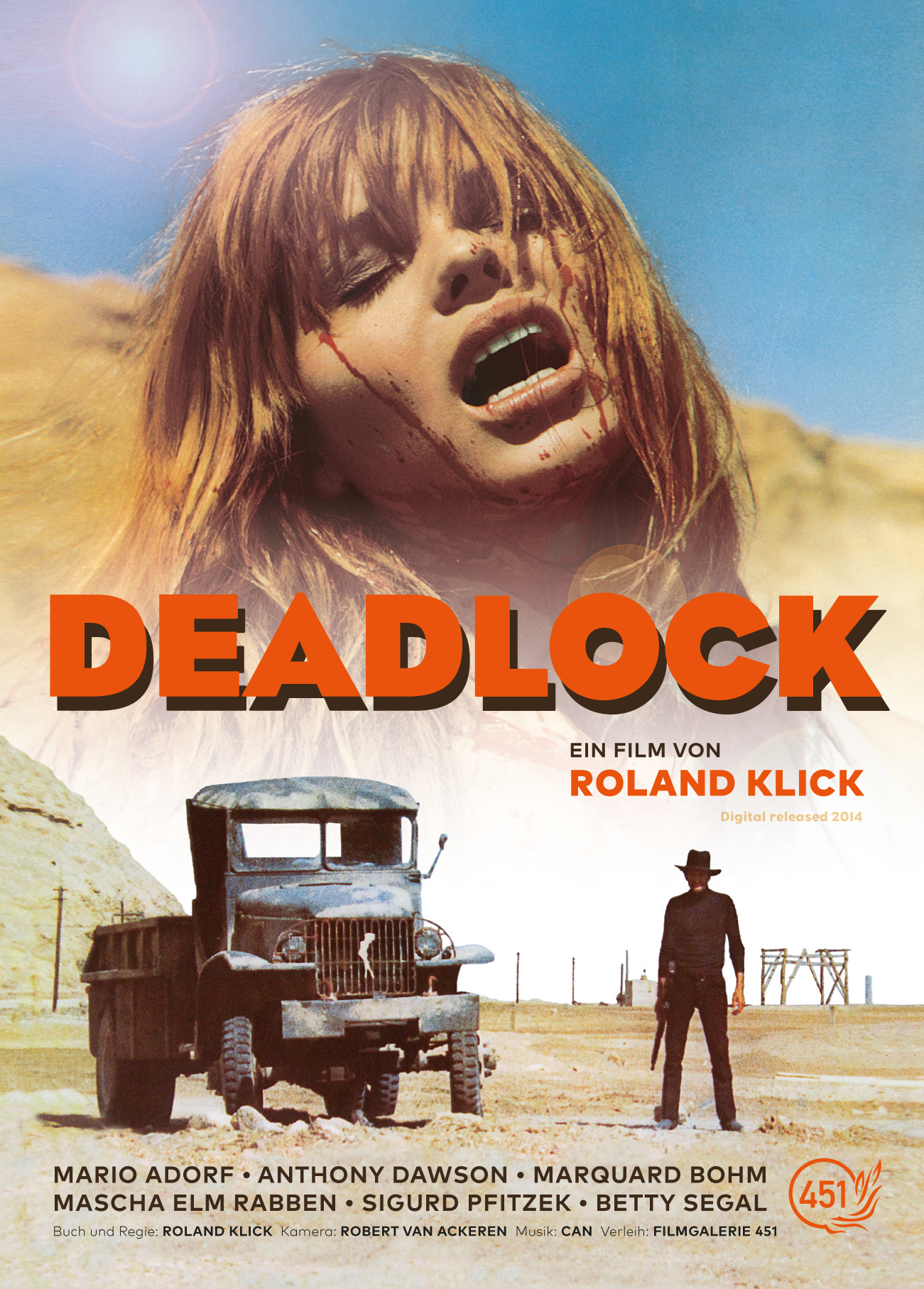
Deadlock

Roland Kluge tried to make a Spaghetti Western film in German. Spaghetti Western is quite difficult to do in the German landscape. The shooting of the film “Deadlock” was done in Negave desert. No one specifically mentioned the “location” of the story in the movie. The first scene shows a tired, devastated man carrying a suitcase. In the middle of the desert, he became unconscious. A man saw him and took him to his house. The place where his house is, is a deported mining town. Gradually, it became known that the man with the suitcase had robbed the bank. He is waiting for his partner. His partner will also come to the place with the rest of the loot, and they will share the loot. The man who brought that guy into a home is a driver. The story doesn’t say much but we can assume that he used to work in mines once. His life is not going anywhere. He is waiting for an opportunity so that he can improve his life. Seeing the suitcase full of the man he had brought home, the driver was hopeful.
For the most part, the film was slow (unlike most Spaghetti westerns). It was most interested in observing the characters but it would take a turn when the guy’s partner Sunshine would make an appearance. Although the film is set in the real world, it seems different in many places. At times, it goes beyond reality and it gives a feeling of absurdity. Germany band Can’s soundtrack gave that feel as well.

Top 10 films of 2019

  1. Vitalina Varela (Country: Portugal)
  2. About Endlessness (Country: Sweden)
  3. Ghost Town Anthalogy (Country: Canada)
  4. Uncut Gems (Country: America)
  5. The Lighthouse (Country: America)
  6. Kumbalangi Nights (Country: India)
  7. Jallikattu (Country: India)
  8. Atlantics (Country: Senegal)
  9. Martin Eden (Country: Italy)
  10. Knives Out (Country: America)

    Honourable mentions: Les Misérables, Marriage Story, Parasite.


Martin Eden

Director: Pietro Marcello
Stars:  Luca MarinelliJessica Cressy

Ever since I saw the picture, I have been thinking that I have to write something about it. But I could not understand how to write that. But the picture is not that incomprehensible. Martin Eden is the lead character of this film. He falls in love with the daughter of a rich man. Martin’s education is meagre. For his love’s sake, he goes to school again. After going to school, he decides that he wants to be a writer. The more Martin studies, the more the distance between him and his lover increases. He started writing from a rented house in the village. Most of his writings are sad, and very few people like them. But fortunately, a magazine agreed to print his novel. Gradually he started to become famous. Meanwhile, he gets involved in some political issues. He was skeptical about the role of the individual in socialism. As he grew older, he became cynical in nature. When he was younger, some of his ideas were clear. But with age, he became more complicated.
It is not clear what period the story belongs to. The clothes look like 1920, but some houses look like 1940-1950. The newsreel of the silent Age is shown at the beginning of the movie. The director wanted to make it clear that duration is not important here.
Marinelli is a force of nature in every scene and doesn’t play Eden so much as inhabit him.


link:- https://www.imdb.com/title/tt4516162/

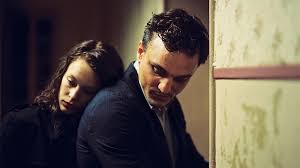
Transit

Directed by :- Christian Petzold.
Stars:- Franz Rogowski, Paula Beer.

Georg, a German political refugee currently resides in Paris. He is responsible for delivering the letter to a writer. He went to his house and saw that the gentleman had committed suicide. It was at this time that the arrests began in Paris. He took a train to visit Marseille. He met a man on the train but he died in the middle of the train. When he reached Marseille, he passed the news to his wife and son. Meanwhile, in the course of events, he had a talk with the writer’s wife. Later the two fell in love. You have to see the picture to see what happens next.
While watching this film, you will realise that it is difficult to predict the time period. Police in Paris are arresting German refugees but there is no way to understand the time. We will see some modern cars on the road, meanwhile there is no sign of internet or mobile. By doing this, this film wants to say that the old refugee crisis still exists. Time is immaterial here.
We see the main character of the film in different ways. His relationship with the boy is like that of a father-son relationship. Then he fell in love with the writer’s wife. There he took the role of a lover.
He has lost his identity somewhere while trying to play these various characters. He somehow lost his own identity. That is exactly what happens when you are a refugee. And surprisingly, you don’t feel anything for the lead character. Perhaps the issue is so much normalized that we don’t feel anymore for the people who don’t have any land to stay. A fine film by Christian Petzold.

Cave of forgotten dreams

On Sunday 18 December 1994, Jean-Marie Chauvet and his two friends Éliette Brunel and Christian Hillaire accidentally discovered this cave. For a short period, the public could visit the cave. But it soon became evident that human intrusions were changing the atmosphere of the cave, so the French Government decided to close it for the public. The cave is 32,000 years old. Herzog gained a rare permit to bring his cameras into the Chauvet cave to document these special drawings from the Paleolithic era. Herzog was given one week time to complete his work. He could only work for 4 hours/day. Herzog used 3-D cameras to shoot the interiors of the cave. This cave contains paintings of Palaeolithic human beings. Palaeolithic humans used to live in the earliest chunk of the stone age. They used stones to make tools. Many years ago, the cave was sealed by a landslide. It helped to preserve everything perfectly. Herzog was not a fan of 3D, but he viewed it as necessary to capture paintings that made extensive use of the curves and contours of the cave’s walls. The cave contains pictures from Hynes to bison to Rhinos. They qualify as the oldest cave art ever discovered. Herzog asks a variety of scientists about the paintings in the cave. At times, he asks them absurd philosophical questions which provide a different perspective to us. The last 30 minutes of this documentary is pure bliss. Herzog reminds us these paintings represent the birth of the modern human soul. “

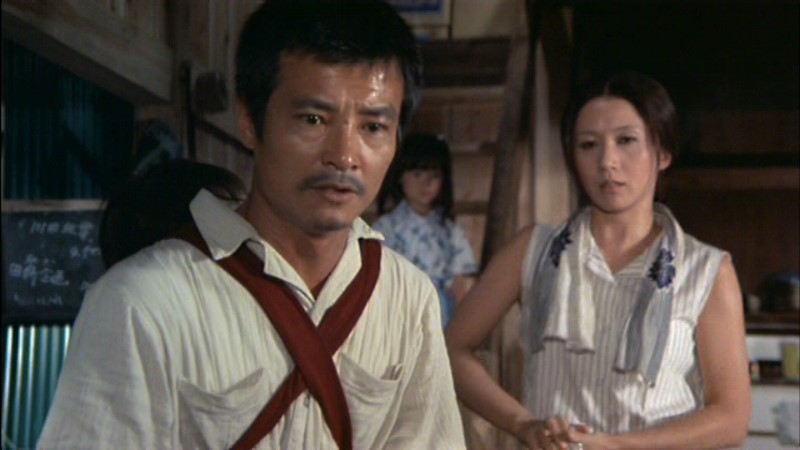
The Demon


Directed by-  Yoshitarô Nomura
Stars : – Ken Ogata, Shima Iwashita


Sokichi (Ken Ogata) doesn’t earn enough money, and he stops providing enough money to his long time lover Kikuyo. They have 3 children as well. In the meantime, Sokichi married another woman called Oume (Shima Iwashita). Kikuyo comes to his house and leaves 3 of their children. In one night, she mysteriously disappears. Being brainwashed by her wife Oume, Sokichi tries to get rid of his kids one by one. The Demon is one of the finest achievements of Japanese cinema in the 1970s. Its account of child abuse is made all the more unsettling by Nomura’s stylistic detachment and by the relatively sympathetic characterisation of the unwillingly abusive protagonist. First of all, this film does not show any woman in a positive light. It doesn’t hold patriarchy responsible for any actions, and it is not necessary either. In some cases, women do more harm in the family than men, and it shows that. Here the demon is “Ken Ogata” who tries to commit the crime. The film concentrates on child abuse, and it shows that without taking the help of bloodbath. Ken Ogata is a demon in his intentions, but ultimately he is a human being. Even though the film is about the child, the most helpless and tragic character of the film is the perpetrator himself. There lies this film’s success and Ken Ogata is just out of the world.

Giraffe


Director: Anna Sofie Hartmann
Starring –  Lisa Loven Kongsli

Norwegian star Lisa Loven Kongsli plays Dara, who is working on an oral history project in the Danish island of Lolland, where a new tunnel connecting Denmark to Germany is being built. Currently, she lives in Berlin but her homeland is Denmark. For her project, she has to visit the southern part of her homeland. Many houses will be demolished to accommodate the development. Dara meets with many locals to know about their feelings. Most of the locals are unhappy to move into a new location. She meets at least one couple who are content with the compulsory purchase.
She explores a deserted house and finds the diary of a librarian named Agnes. The interactions with the locals reveal conflicting attitudes to the draw of place and the meaning of home. Dara meets with a Polish man named Lucek and starts a brief romantic relationship with him. Dara has a boyfriend in Berlin. The film explores a different facet of human emotions. The locals have to move into their new homes and they are not happy leaving their old homes. In the case of Dara and the Polish guy, their case is different. Dara is staying at a place which is much different than the one where she was brought up in the same country. Also, it is much different than her current home in Berlin.
In that new place, she needed a partner to keep her motivated. Same is for her partner Polish guy who had to leave his home for work. However, unlike the locals, it is not clear if they are happy or sad living there. Anna Sofie Hartmann shows a lot of promise in her debut feature Giraffe. “Giraffe” makes no explicit judgement on what we call progress. “It’s sad that it will be covered in asphalt and turned into a highway,” Leif Nielson tells Dara, speaking of his family farm. “So that is sad – but that’s progress, you can’t stop it.”

Morgiana


After hearing that their father gave most of his fortunes to his younger sister Klára (Iva Janzurová), Viktorie (same actress) planned to kill her. She poisoned Klara’s tea with a slow-acting fatal substance. But the poison turned out to be not so harmful. Instead of dying, her younger sister started hallucinating dreams. What happened next? Watch it to know more about it. If I may call it, this film is one of the best melodramatic films I have ever seen. Everything from the costumes and makeup is so over the top that at times one might forget that both the characters are played by the same actor. The excessive usage of color gives the film almost a fairy-tale vibe. Music plays a big part in creating a haunting atmosphere. It seems that the story takes place during the late 19th century in a remote Czech town. There is no attempt at social commentary here. If one tries to find out their inner meaning through a Gothic fairy-tale, they are going to be disappointed. Barring the lead, the performances are theatrical, which does suit the mood of the film. The title of the film “Morgiana” is the name of Klára’s cat.  She was the one who knew about Viktorie’s plans from the beginning itself.  She offers another perspective to the story